Highlands Career Exploration Supplement
VII. Exploring Occupations & Careers
Ability Patterns - Continued
Your combination of abilities reveal patterns which will provide a deeper understanding of careers and
work roles that will align with your ability profile.Highlands Affiliates have identified patterns of abilities from decades of experience in career development. Using statistical analyses, we have compared the Ability Patterns to your profile and rank ordered them from strongest to weakest fit. Listed below are the patterns that are the closest match to your Ability Profile. A complete description for each of the patterns is provided along with suggested careers to explore. Open up your report on line, and click on any career listed to explore it on O*NET As you review the lists of suggestions, take into account your acquired knowledge and skills as well as your experience with and preferences for specific work activities.
 Ability Patterns - Connections to Abilities
 Very Clear Connection to Abilities
 Somewhat Clear Connection to AbilitiesClick Each Pattern Online for Full Description
Highlands Career Exploration Supplement
Problem Solving - Practical Analytical
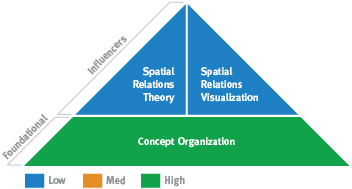

Abilities Constituting This Pattern
This pattern combines Analytical Problem Solving (Concept Organization) with intangible, practical spatial abilities (lower Spatial Relations Theory and Visualization). The first ability to take into account is your strong Concept Organization. With strong Concept Organization, you are able to solve problems most easily by projecting logical consequences into the future. This ability also enables you to communicate your ideas to other people in a way that they can easily understand. People with this particular combination of abilities often enjoy functioning in a planning role. They are able to deal with problems in a rigorous, logical and linear manner that lends itself easily to projections and forecasting the future.
100

0

•

Concept Organization
100
0

•
Spatial Relations Theory
100
0

•
Spatial Relations Visualization

Your Scores (black dots) Relative To Required Ability Range
Additionally, your scores on the two spatial abilities reinforce each other. You are not going to relate well to mathematics or physical, three-¬dimensional space and objects. You are much more comfortable dealing in the intangible world of people, relationships, and ideas.
This combination of driving abilities is seen quite often in people who consult as an expert for others. Travel agents, writers, and events planners all use this set of abilities. In addition, it is often used by professors and people who consult in organizations and systems, especially in regard to long range strategy or plans.
This combination of driving abilities is seen quite often in people who consult as an expert for others. Travel agents, writers, and events planners all use this set of abilities. In addition, it is often used by professors and people who consult in organizations and systems, especially in regard to long range strategy or plans.
See next page for CAREERS TO EXPLORE.
Highlands Career Exploration Supplement
Careers to Explore for Problem Solving - Practical Analytical
Organized by Job Families which are groups of occupations based upon work performed, skills, education, training and credentials.
Highlands Career Exploration Supplement
Problem Solving - Idea-rich Analytical Practical
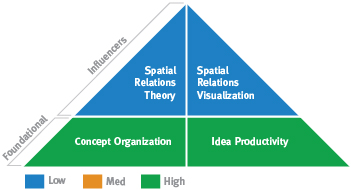
Abilities Constituting This Pattern
This pattern utilizes idea-rich (Idea Productivity) Analytical Problem Solving (Concept Organization) in the intangible world. The first ability to take into account is your Strong Concept Organization. With strong Concept Organization, you are able to solve problems most easily by projecting logical consequences into the future. This ability also enables you to communicate your ideas to other people in a way that they can easily understand. People with this particular ability often enjoy functioning in a planning role. They are able to deal with problems in a rigorous, logical and linear manner that lends itself easily to projections and forecasting the future.
Strong Idea Productivity can help not only with problem solving, since it allows you to come up with many possibilities, but also with communicating, since you are more easily able to think of different ways to put your ideas so that people will understand them. This can help in situations in which you are teaching or convincing others of the rightness of your ideas.
Strong Idea Productivity can help not only with problem solving, since it allows you to come up with many possibilities, but also with communicating, since you are more easily able to think of different ways to put your ideas so that people will understand them. This can help in situations in which you are teaching or convincing others of the rightness of your ideas.
100
0
•
Concept Organization
100
0
•
Idea Productivity
100
0
•
Spatial Relations Theory
100
0

•
Spatial Relations Visualization
Your Scores (black dots) Relative To Required Ability Range
Additionally, your scores on the two spatial abilities reinforce each other. You are not going to relate well to mathematics or physical, three-dimensional space and objects. You are much more comfortable dealing in the intangible world of people, relationships, and ideas.
This combination of driving abilities is seen quite often in people who consult as an expert for others. Counselors, writers, and planners all use this set of abilities. In addition, it is often used by professors and people who consult in organizations and systems, especially in regard to long range strategy or plans.
This combination of driving abilities is seen quite often in people who consult as an expert for others. Counselors, writers, and planners all use this set of abilities. In addition, it is often used by professors and people who consult in organizations and systems, especially in regard to long range strategy or plans.
See next page for CAREERS TO EXPLORE.
Highlands Career Exploration Supplement
Careers to Explore for Problem Solving - Idea-rich Analytical Practical
Organized by Job Families which are groups of occupations based upon work performed, skills, education, training and credentials.
Highlands Career Exploration Supplement
Problem Solving - Practical Consultative
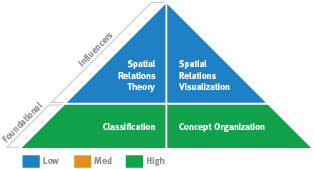
Abilities Constituting This Pattern
This pattern combines Consultative Problem Solving (Classification and Concept Organization) with intangible, practical spatial abilities (lower Spatial Relations Theory and Visualization). The first abilities to take into account are your relatively strong scores in Classification and Concept Organization. These abilities allow you to solve problems quickly and easily, communicate your conclusions to others compellingly, and plan strategic moves and consequences. People with this particular combination of abilities often enjoy functioning in an expert role. They are able to deal with problems quickly, and help others understand the solution. They can combine more rapid, non logical problem solving with more rigorous, logical and linear problem solving.
100
0
•
Classification
100
0
•
Concept Organization
100
0
•
Spatial Relations Theory
100
0
•
Spatial Relations Visualization
Your Scores (black dots) Relative To Required Ability Range
Additionally, your scores on the two spatial abilities reinforce each other. You are not going to relate well to mathematics or physical, three¬-dimensional space and objects. You are much more comfortable dealing in the intangible world of people, relationships, and ideas.
This combination of abilities is seen quite often in people who can make quick decisions and communicate those decisions to others. Writers, editors, lawyers, and directors of organizations all use this set of abilities.
This combination of abilities is seen quite often in people who can make quick decisions and communicate those decisions to others. Writers, editors, lawyers, and directors of organizations all use this set of abilities.
See next page for CAREERS TO EXPLORE.
Highlands Career Exploration Supplement
Careers to Explore for Problem Solving - Practical Consultative
Organized by Job Families which are groups of occupations based upon work performed, skills, education, training and credentials.Architecture and EngineeringErgonomistsArts, Design, Entertainment, Sports, MediaBroadcast News Analysts Editors Reporters and CorrespondentsBusiness and Financial OperationsAgents & Business Managers of Artists Credit Analysts Financial Quantitative Analysts Market Research Analysts Sustainability SpecialistsCommunity and Social ServiceDirectors, Religious Activities & EducationComputer and MathematicalActuaries |
Data Analytics Specialist
Nurse Clinical Informatics SpecialistsHealthcare Practitioners and TechnicalInternists, General Naturopathic PhysiciansLegalLawyersLife, Physical, and Social ScienceAnthropologists Environmental Scientists Geneticists Geographers Industrial Ecologists Industrial-Organizational Psychologists |
Medical Scientists
Meteorologist, Space Scientists
Remote Sensing Scientists
Soil and Plant ScientistsManagementHuman Resources Managers Legislators Natural Sciences Managers |
Highlands Career Exploration Supplement
Writing/Planning
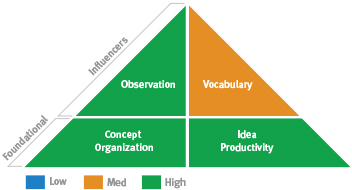
Abilities Constituting This Pattern
The basic Writing/Planning pattern combines idea-rich Analytical Problem Solving with attention to visual detail (Observation) and a relatively strong General Vocabulary. Concept Organization provides the natural ability to organize thoughts in a way that others can easily understand and follow. Observation facilitates noticing and filing away subtleties that enhance the writing and make it convincing. General Vocabulary helps to supply the words needed to articulate and play with the numerous ideas generated. Developing a specialized vocabulary and knowledge base can add substance to new ideas just beginning to form. Input of any kind (podcasts, articles, etc.) will enable expansion of those ideas and keep the creative juices flowing.
Extroversion or a Generalist orientation might draw you toward occupations that have a strong planning component as opposed to purely writing. Strong Concept Organization combined with Extroversion makes this profile all about getting plans done, accomplishing something, and sharing that triumph with others. Careers with strong planning components such as event planning and campaign managing both have a need for written communication.
Extroversion or a Generalist orientation might draw you toward occupations that have a strong planning component as opposed to purely writing. Strong Concept Organization combined with Extroversion makes this profile all about getting plans done, accomplishing something, and sharing that triumph with others. Careers with strong planning components such as event planning and campaign managing both have a need for written communication.
100
0
•
Concept Organization
100
0
•
Idea Productivity
100
0
•
Observation
100
0
•
Vocabulary
Your Scores (black dots) Relative To Required Ability Range
As a person whose abilities fit this basic Writing/Planning pattern, you should experiment with writing. If you bring other abilities to the table they might give you an idea of a direction to explore. For instance, if you add either of the Spatial Relations abilities, you may be interested in technical writing for a technology company or non-fiction writing in an area of interest. If you bring strong Design Memory you may be drawn to fiction or science fiction.
The technology we now have to communicate opens doors for writers in new and exciting ways. There are so many ways for a writer to get paid for writing. Experimenting with writing blogs, short stories, or even the challenge of the brief communication styles of text communication can invigorate the writer in you and give you a place to explore your style and choose a career path.
The technology we now have to communicate opens doors for writers in new and exciting ways. There are so many ways for a writer to get paid for writing. Experimenting with writing blogs, short stories, or even the challenge of the brief communication styles of text communication can invigorate the writer in you and give you a place to explore your style and choose a career path.
See next page for CAREERS TO EXPLORE.
Highlands Career Exploration Supplement
Careers to Explore for Writing/Planning
Organized by Job Families which are groups of occupations based upon work performed, skills, education, training and credentials.
Highlands Career Exploration Supplement
Communicating
Abilities Constituting This Pattern
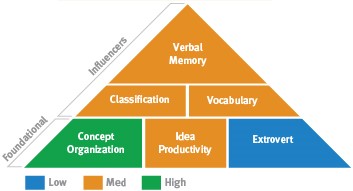
This pattern combines a low to moderate level of Extroversion with a continuous flow of ideas (Idea Productivity) and the ability to organize and communicate them in a way that is easy to follow (Concept Organization) in a relatively fast-pasted environment (moderate to strong Classification). At least a moderate ability to remember what is read (Verbal Memory) and General Vocabulary are also important. People with this pattern can quickly and easily generate a large number of ideas. They can think of a new approach to communicate a thought, if the approach they begin with is not understandable to the audience. Organizing ideas and information is a natural, internal process for people with this pattern. They excel in creating or listening for logic tracks. This ability pattern is foundational for a wide variety of careers in communications.
100
0
•
Classification
100
0
•
Concept Organization
100
0
•
Idea Productivity
100
0
•
Extrovert
100
0

•
Verbal Memory
100
0

•
Vocabulary
Your Scores (black dots) Relative To Required Ability Range
The Communicating pattern can apply to oral and written communication. The stronger your Introversion, the more comfortable you will be if you are given time to organize your thoughts before you give a speech or presentation. The stronger your Classification, the more likely you will be able to think on your feet. Your strong Concept Organization keeps you from enjoying rapid fire problem solving, but you should easily be able to follow the twists and turns of a logical argument, and form a response with ease.
Good Verbal Memory and Vocabulary should provide you with the necessary tools to communicate any thought thoroughly. You will likely be a reader who enjoys being informed of changes in the world or your industry. Keeping up with information may be one of your favorite pastimes, and in our communication rich world your innate abilities will be desirable in any industry needing creative communicators.
Good Verbal Memory and Vocabulary should provide you with the necessary tools to communicate any thought thoroughly. You will likely be a reader who enjoys being informed of changes in the world or your industry. Keeping up with information may be one of your favorite pastimes, and in our communication rich world your innate abilities will be desirable in any industry needing creative communicators.
See next page for CAREERS TO EXPLORE.
Highlands Career Exploration Supplement
Careers to Explore for Communicating
Organized by Job Families which are groups of occupations based upon work performed, skills, education, training and credentials.
Highlands Career Exploration Supplement
Sensing - Creative
Abilities Constituting This Pattern
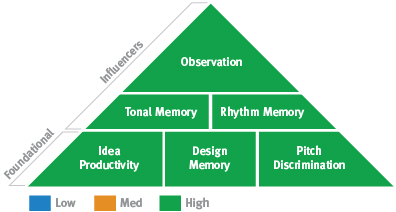
You have many creative abilities, and you will want to pay attention to these talents. Your Idea Productivity, Design Memory, and Pitch Discrimination combine to point you in a creative and artistic direction. You are able to think of many ways of doing something. You can remember the overall pattern of something, and you are sensitive to small nuances of change and the effects of such a change. For example, if you were painting a picture, you could have several ideas for the picture, you could grasp the overall pattern that you were trying to produce, and you would be aware of subtle changes in shape or color. These abilities can be applied in many fields, not just visual art. They allow you to be creative with any kind of task you may wish to do.
Additionally, you have Musical abilities, as reflected by your scores in Tonal Memory, Rhythm Memory, and Pitch Discrimination. Your Musical abilities will press to be used. You might enjoy playing an instrument, singing, dancing, or taking part in other forms of musical expression. Your scores suggest that you would derive great pleasure by including music as a part of your life.
Additionally, you have Musical abilities, as reflected by your scores in Tonal Memory, Rhythm Memory, and Pitch Discrimination. Your Musical abilities will press to be used. You might enjoy playing an instrument, singing, dancing, or taking part in other forms of musical expression. Your scores suggest that you would derive great pleasure by including music as a part of your life.
100
0
•
Idea Productivity
100
0
•
Design Memory
100
0
•
Observation
100
0
•
Tonal Memory
100
0
•
Rhythm Memory
100
0
•
Pitch Discrimination
Your Scores (black dots) Relative To Required Ability Range
Your Design Memory and Observation scores suggest that you also have good Visual abilities. You may feel quite at home and productive in a field that is strongly visual.
The fact that you possess so many creative abilities has several implications for you. You are very tuned to your sensory experiences. You notice the details and nuances of many situations and these details are important to you. You will enjoy an environment that is aesthetically pleasing, and you will be aware of small differences in many sensory areas. You will want to choose a career field and other activities that give you opportunities to express your highly creative side.
The fact that you possess so many creative abilities has several implications for you. You are very tuned to your sensory experiences. You notice the details and nuances of many situations and these details are important to you. You will enjoy an environment that is aesthetically pleasing, and you will be aware of small differences in many sensory areas. You will want to choose a career field and other activities that give you opportunities to express your highly creative side.
See next page for CAREERS TO EXPLORE.
Highlands Career Exploration Supplement
Careers to Explore for Sensing - Creative
Organized by Job Families which are groups of occupations based upon work performed, skills, education, training and credentials.Arts, Design, Entertainment, Sports, MediaActors Art Directors Choreographers Craft Artists Dancers Directors- Stage, Motion Pictures Fashion Designers Film & Video Editors Fine Artists, Including Painters, Sculptors Floral Designers Graphic Designers Interior Designers |
Multimedia Artists & Animators
Music Composers & Arrangers
Music Directors
Musicians, Instrumental
Photojournalist
Set & Exhibit Designers
Singers
Sound Engineering Technicians
Talent DirectorsComputer and MathematicalVideo Game DesignersEducation, Training, and LibraryArt, Drama, Music Teacher Audio Visual Multimedia | Healthcare Practitioners and TechnicalArt Therapists Music Therapists Speech-Language PathologistsHealthcare SupportSpeech-Language Pathology AssistantsInstallation, Maintenance, and RepairMusical Instrument Repairers & TunersPersonal Care and ServiceAnimal Trainers Hairdressers & CosmetologistsProductionJewelers |
Highlands Career Exploration Supplement
Writing - Creative
Abilities Constituting This Pattern
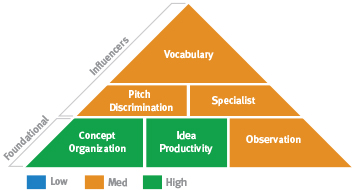
This pattern combines a Specialist orientation with idea-rich Analytical Problem Solving (Idea Productivity, Concept Organization), attention to environmental details (Observation and Pitch Discrimination), and a relatively strong General Vocabulary. People with this pattern are able to prioritize their ideas and put them in a logical form that others can easily understand. The Writing- Creative pattern is also about experimenting with words and communication. A wide Vocabulary and general wealth of knowledge will bring substance to written works, and Observation will provide the details that bring the writing to life. The addition of Pitch Discrimination enhances descriptions of nuances and subtleties such as smells, texture and colors.
A person with this basic Writing- Creative pattern is generally a creative person. Depending on the other abilities that are present, they may find themselves in any number of creative fields, although probably always working to communicate in some way. A person with this basic pattern and the addition of Classification may be interested in solving problems and creating intuitive models for others to explore. This particular combination would be highly valued in video game design copy writing or screenplay writing. With the addition of Spatial Relations Theory, writing psychological thrillers or high fantasy novels might be interesting. Often what you are naturally drawn to as a reader is a good indicator of what you would be inspired by as a writer.
A person with this basic Writing- Creative pattern is generally a creative person. Depending on the other abilities that are present, they may find themselves in any number of creative fields, although probably always working to communicate in some way. A person with this basic pattern and the addition of Classification may be interested in solving problems and creating intuitive models for others to explore. This particular combination would be highly valued in video game design copy writing or screenplay writing. With the addition of Spatial Relations Theory, writing psychological thrillers or high fantasy novels might be interesting. Often what you are naturally drawn to as a reader is a good indicator of what you would be inspired by as a writer.
100
0
•
Concept Organization
100
0
•
Specialist
100
0
•
Idea Productivity
100
0
•
Observation
100
0
•
Pitch Discrimination
100
0
•
Vocabulary
Your Scores (black dots) Relative To Required Ability Range
If you also have moderate Rhythm Memory, you can “hear” what you write although it brings with it a sense of restlessness that might inhibit your ability to sit and write for long periods of time. If your Spatial Relations scores are moderate to strong, you are able to understand machines or technical processes well enough to use them as believable plot points.
If you are more Introverted, you may prefer to work freelance or in a writing role in an organization. This would allow some protection from constant contact with others. You would thrive in writing or planning work that involves a good deal of self-starting and limited contact with other people.
If you are more Introverted, you may prefer to work freelance or in a writing role in an organization. This would allow some protection from constant contact with others. You would thrive in writing or planning work that involves a good deal of self-starting and limited contact with other people.
See next page for CAREERS TO EXPLORE.
Highlands Career Exploration Supplement
Careers to Explore for Writing - Creative
Organized by Job Families which are groups of occupations based upon work performed, skills, education, training and credentials.Arts, Design, Entertainment, Sports, MediaEditor Interpreters & Translators Journalist Poets, Lyricists & Creative Writers Producer-Writer Multi Media Reporters & CorrespondentsEducation, Training, and LibraryEnglish Language & Literature Teachers | ManagementAdvertisingOffice and Administrative SupportDesktop Publishers |
Highlands Career Exploration Supplement
Sensing - Musical Connection
Abilities Constituting This Pattern
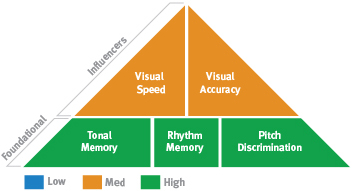
The Musical Connection pattern combines natural Musical ability (Tonal Memory, Rhythm Memory, Pitch Discrimination) with relatively strong Visual Proficiency (Visual Speed and Accuracy). While this pattern can accommodate any personal style, Specialist/Introverts may have an edge in the highly competitive music industry because of their intense drive for perfection in one area of interest. At the very least, a person whose abilities fall into this pattern will be aware of music and enjoy it in one way or another through all of life.
The musical abilities come together in a unique way to create the physical ability to hear music and the abilities to remember and reproduce music. In the strongest ranges, Tonal Memory is the ability to remember melodies and harmonies and Pitch Discrimination is the ability to differentiate between pitches with uncanny accuracy. The stronger the Pitch Discrimination, the stronger the ability to hear the different notes played in a melody and possibly reproduce them with a high degree of accuracy. The stronger the Rhythm Memory, the better the ability to remember and reproduce the cadence or rhythm of what is heard. The addition of Visual Speed and Visual Accuracy enhances reading music and, they can be helpful in handling the paperwork involved in the role of composer. In combination, these abilities will likely produce in you, pressure to be connected to music in a strong way. This pressure will be felt over a lifetime and outlets can be created vocationally or avocationally.
The musical abilities come together in a unique way to create the physical ability to hear music and the abilities to remember and reproduce music. In the strongest ranges, Tonal Memory is the ability to remember melodies and harmonies and Pitch Discrimination is the ability to differentiate between pitches with uncanny accuracy. The stronger the Pitch Discrimination, the stronger the ability to hear the different notes played in a melody and possibly reproduce them with a high degree of accuracy. The stronger the Rhythm Memory, the better the ability to remember and reproduce the cadence or rhythm of what is heard. The addition of Visual Speed and Visual Accuracy enhances reading music and, they can be helpful in handling the paperwork involved in the role of composer. In combination, these abilities will likely produce in you, pressure to be connected to music in a strong way. This pressure will be felt over a lifetime and outlets can be created vocationally or avocationally.
100
0
•
Pitch Discrimination
100
0
•
Rhythm Memory
100
0
•
Tonal Memory
100
0
•
Visual Accuracy
100
0
•
Visual Speed
Your Scores (black dots) Relative To Required Ability Range
Being able to hear and reproduce melodies and rhythm does not guarantee success however. Just because you have the musical abilities to hear music, does not mean becoming proficient on an instrument or composing is a given. Some added abilities in Classification, and Concept Organization would be helpful for learning an instrument, and some level of Idea Productivity and Spatial Relations Theory would be helpful for composition. But as with any career that requires skill, success in musical careers is usually a mix of some natural talent and massive amounts of hard work.
See next page for CAREERS TO EXPLORE.
Highlands Career Exploration Supplement
Careers to Explore for Sensing - Musical Connection
Organized by Job Families which are groups of occupations based upon work performed, skills, education, training and credentials.Arts, Design, Entertainment, Sports, MediaArt, Drama, Music Teacher Dancers Multimedia Artists & Animators Music Composer Music Directors Musicians, Instrumental Singer Sound Engineer |
Talent DirectorsHealthcare Practitioners and TechnicalMusic TherapistsInstallation, Maintenance, and RepairMusical Instrument RepairerPersonal Care and ServiceFitness Trainers & Instructors |
Highlands Career Exploration Supplement
Arranging - Creative
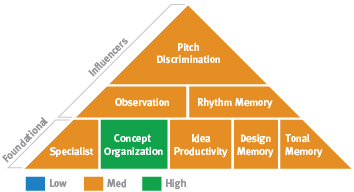
Abilities Constituting This Pattern
This pattern combines a Specialist orientation with Analytical Problem Solving (Concept Organization) and relatively strong Visual and Musical abilities (Design Memory, Observation and Tonal Memory, Rhythm Memory, Pitch Discrimination). They prefer to work alone and not be as involved in the showing of their work.
Good Idea Productivity is important to this pattern. It fuels thoughts about subjects or topics to depict and ways to approach the creative task. Additional abilities point to an artistic or creative direction. The visual and music abilities indicate a heightened sensitivity to your sensory experiences. People with this pattern notice, appreciate, and attach importance to the details and nuances of many types of situations, not just art and music. When they find a medium of artistic or creative expression, they are often able to communicate their generally heightened critique of experiences to others.
Good Idea Productivity is important to this pattern. It fuels thoughts about subjects or topics to depict and ways to approach the creative task. Additional abilities point to an artistic or creative direction. The visual and music abilities indicate a heightened sensitivity to your sensory experiences. People with this pattern notice, appreciate, and attach importance to the details and nuances of many types of situations, not just art and music. When they find a medium of artistic or creative expression, they are often able to communicate their generally heightened critique of experiences to others.
100
0
•
Concept Organization
100
0
•
Design Memory
100
0
•
Specialist
100
0
•
Idea Productivity
100
0
•
Observation
100
0
•
Pitch Discrimination
100
0

•
Rhythm Memory
100
0

•
Tonal Memory
Your Scores (black dots) Relative To Required Ability Range
When the basic components of this pattern are combined with high Concept Organization, you are also a good match for artistic and creative fields requiring you to logically organize and arrange things or ideas. Investigating careers such as Museum Curator, or Historical Restoration Specialist might lead you to a path less travelled but nonetheless interesting to your unique sensibilities.
See next page for CAREERS TO EXPLORE.
Highlands Career Exploration Supplement
Careers to Explore for Arranging - Creative
Organized by Job Families which are groups of occupations based upon work performed, skills, education, training and credentials.Architecture and EngineeringMapping TechniciansArts, Design, Entertainment, Sports, MediaArt Director Choreographer Commercial & Ind. Designer Fashion Designer Film & Video Editor Fine Artist Floral Designers Graphic Designer Interior Designer Multimedia Artists & Animators |
Music Composer & Arranger
Music Director
Set and Exhibit Designer
Sound Engineer Technician
Talent Directors
Technical Directors/ManagersComputer and MathematicalTelecommunications Engineering Video Game Designer Web DeveloperEducation, Training, and LibraryArt, Drama, Music Teacher Communications Teachers |
Curator
Instructional Designer
Museum Technician and ConservatorsHealthcare Practitioners and TechnicalArt Therapists Music TherapistsLife, Physical, and Social ScienceHistoriansManagementAdvertisingProductionJewelers |
Highlands Career Exploration Supplement
Specializing - Creative
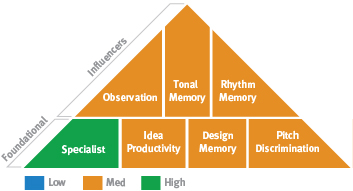
Abilities Constituting This Pattern
This pattern combines a Specialist orientation, rich idea generation (Idea Productivity), and Musical (Tonal Memory, Rhythm Memory, Pitch Discrimination) and Visual abilities (Design Memory, Observation). People with this pattern are artists who prefer to delve into activities that will increase their expertise. Typically a person involved in a creative specialty will be driven by interest or passion to know or understand something unique and powerful. Self-awareness will be valuable as you begin to explore the artistic realm and seek a way to make your interest or passion come to life.
Idea Productivity is important to this pattern because it enables creative specialists to think of many different subjects or topics to depict, and many different ways to approach the task. The visual abilities and music abilities indicate a heightened sensitivity to sensory experiences. People with this pattern notice, appreciate, and attach importance to the details and nuances of many types of situations, not just art and music. Experiencing a new type of artistic or creative expression enables those with this pattern to communicate their generally heightened sensory experiences to others.
Idea Productivity is important to this pattern because it enables creative specialists to think of many different subjects or topics to depict, and many different ways to approach the task. The visual abilities and music abilities indicate a heightened sensitivity to sensory experiences. People with this pattern notice, appreciate, and attach importance to the details and nuances of many types of situations, not just art and music. Experiencing a new type of artistic or creative expression enables those with this pattern to communicate their generally heightened sensory experiences to others.
100
0
•
Design Memory
100
0
•
Specialist
100
0
•
Idea Productivity
100
0
•
Observation
100
0
•
Pitch Discrimination
100
0
•
Rhythm Memory
100
0
•
Tonal Memory
Your Scores (black dots) Relative To Required Ability Range
If you also have medium to high Concept Organization, you might be able to turn your critical thinking into a career as an art or theater critic, or any other artistic and creative fields requiring you to logically organize and arrange things. If you are more Extroverted, adding a social component to your artistry could make you a powerful performance artist.
See next page for CAREERS TO EXPLORE.
Highlands Career Exploration Supplement
Careers to Explore for Specializing - Creative
Organized by Job Families which are groups of occupations based upon work performed, skills, education, training and credentials.Architecture and EngineeringArchitect Robotics TechniciansArts, Design, Entertainment, Sports, MediaArt Director Choreographer Commercial & Industrial Designer Craft Artist Dancers Fashion Designer Film & Video Editor Fine Artist Floral Designers |
Graphic Designer
Interior Designer
Multimedia Artists & Animators
Music Composer & Arranger
Music Director
Musician Instrumental
Photographer
Set and Exhibit Designer
Sound Engineer Technician
Talent DirectorsComputer and MathematicalVideo Game Designer |
Web DeveloperEducation, Training, and LibraryCommunications Teachers Curator Instructional DesignerHealthcare Practitioners and TechnicalArt Therapists Music TherapistsManagementAdvertisingProductionJewelers |
Highlands Career Exploration Supplement
Advising
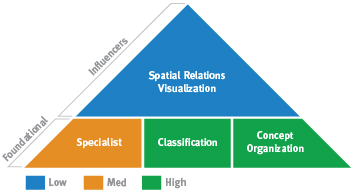
Abilities Constituting This Pattern
This pattern combines a moderate Specialist orientation with a Consultative Problem Solving style (Classification and Concept Organization) in the intangible world (lower Spatial Relations Visualization). People with this pattern make connections rapidly, diagnose interactions quickly, and organize information easily. This Consultative Problem Solving style combines the ability to diagnose what is wrong, and prescribe solutions to fix it. People with this pattern are able to gather and understand a range of un-related information, organize it and present it in a factual and convincing manner. The ability to quickly identify problems, logically look at each step in the process, and then communicate findings in an articulate fashion allows them to work most effectively in a career that demands fast pace and rapid-fire problem solving.
With lower Spatial Relations Visualization, people with this pattern lean toward thinking intangibly and are comfortable dealing with laws, theories, concepts, and ideas, and do not require a tangible or concrete outcome of their work to feel satisfied.
With lower Spatial Relations Visualization, people with this pattern lean toward thinking intangibly and are comfortable dealing with laws, theories, concepts, and ideas, and do not require a tangible or concrete outcome of their work to feel satisfied.
100
0
•
Classification
100
0
•
Concept Organization
100
0
•
Specialist
100
0
•
Spatial Relations Visualization
Your Scores (black dots) Relative To Required Ability Range
You have a natural ability to combine various components into a case or a patterns and to analyze causes. If you are an Extrovert, you might want to investigate public speaking or making presentations about your expertise. If you are an Introvert, you may want to take the lead in research writing and documentation or possibly write a book about your field. If you have a medium to high Spatial Relations Theory score, you may be especially good at working with theoretical and/or interpersonal systems.
Advising has many varied applications and is highly valued in almost any occupational field. The sooner you find your nice and acquire deep knowledge and experience, the sooner you will be able to utilize your natural advising nature.
Advising has many varied applications and is highly valued in almost any occupational field. The sooner you find your nice and acquire deep knowledge and experience, the sooner you will be able to utilize your natural advising nature.
See next page for CAREERS TO EXPLORE.
Highlands Career Exploration Supplement
Careers to Explore for Advising
Organized by Job Families which are groups of occupations based upon work performed, skills, education, training and credentials.
Highlands Career Exploration Supplement
Investigating - Planning
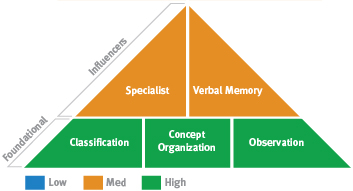
Abilities Constituting This Pattern
This pattern combines a Specialist orientation with a Consultative problem solving style (Classification and Concept Organization), an ability to remember what is read (Verbal Memory) and acute Observation. People with this pattern naturally apply their foot-wide/mile deep approach to seeing details that others might miss and then quickly ascertaining how the pieces fit together. This combination results in a natural attentiveness to visual details related to plans, progress toward goals, or the creation of a scenario from limited pieces of visual information.
This complex set of abilities enables you to conduct investigations and inquiries. You are a logical thinker, able to take what you have observed and make the connections needed to begin the investigation. Next, you can create a plan of action and then communicate the results. Verbal Memory allows you to sift through written material and retain information. This is helpful as you use the diagnostic side of your problem solving (Classification) to make connections with information you have read.
This complex set of abilities enables you to conduct investigations and inquiries. You are a logical thinker, able to take what you have observed and make the connections needed to begin the investigation. Next, you can create a plan of action and then communicate the results. Verbal Memory allows you to sift through written material and retain information. This is helpful as you use the diagnostic side of your problem solving (Classification) to make connections with information you have read.
100
0
•
Classification
100
0
•
Concept Organization
100
0
•
Specialist
100
0
•
Observation
100
0
•
Verbal Memory
Your Scores (black dots) Relative To Required Ability Range
You have strong abilities for investigation and work roles in criminal justice or the legal profession. Many other occupations might interest you as well. This ability pattern itself is a broad set of seemingly unrelated tools that can be used in industries as diverse a library science and zoology. Any career that depends on rapid and logical problem solving, keen observation, and the ability to dig deep into an idea will satisfy you. Review your personal style characteristics for clues about careers where you might feel some natural draw. An Introvert with a Specialist orientation might draw you to careers in writing, planning, or analysis, which depend on working independently. An Extrovert may be more comfortable in people-oriented careers such as financial planning or news reporting.
See next page for CAREERS TO EXPLORE.
Highlands Career Exploration Supplement
Careers to Explore for Investigating - Planning
Organized by Job Families which are groups of occupations based upon work performed, skills, education, training and credentials.
Highlands Career Exploration Supplement
Problem Solving - Analytical, Idea-rich, Hands-on
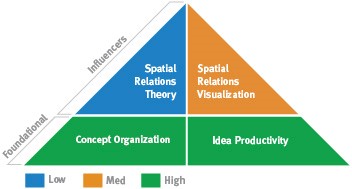
Abilities Constituting This Pattern
This pattern utilizes idea-rich (Idea Productivity) Analytical Problem Solving (Concept Organization) within the hands-on world (Spatial Relations Visualization). The first ability to take into account is your Concept Organization. With strong Concept Organization, you are able to solve problems most easily by projecting logical consequences into the future. This ability also enables you to communicate your ideas to other people in a way that they can easily understand. People with this particular combination of abilities often enjoy functioning in planning roles. They are able to deal with problems in a rigorous, logical and linear manner that lends itself easily to projections and forecasting the future.
Strong Idea Productivity can help not only with problem solving, since it allows you to come up with many possibilities, but also with communicating, since you are more easily able to think of different ways to put your ideas so that people will understand them. This can help in situations in which you are teaching or convincing others of the rightness of your ideas.
Strong Idea Productivity can help not only with problem solving, since it allows you to come up with many possibilities, but also with communicating, since you are more easily able to think of different ways to put your ideas so that people will understand them. This can help in situations in which you are teaching or convincing others of the rightness of your ideas.
100
0
•
Concept Organization
100
0
•
Idea Productivity
100
0
•
Spatial Relations Theory
100
0
•
Spatial Relations Visualization
Your Scores (black dots) Relative To Required Ability Range
Your score in Spatial Relations Visualization makes it easy for you to relate to both the tangible and intangible world. This makes you the perfect interpreter between abstract and concrete people. Your lower score in Spatial Relations Theory indicates that your moderate score in Spatial Relations Visualization may or may not need an outlet. Pay attention to your history, interests, and behavior to decide if a work role feels too intangible or tangible to you. If you enjoy working with tools, have a native understanding of machines, are interested in science or technology, or just enjoy the look, shape and feel of things, you may well prefer work roles that keep you connected to the concrete, tangible world. If, on the other hand, you don't care much about technology, have no seeming native ability with machines, or you don't care much about working with tools or things, you may be more at home with intangible work.
This combination of driving abilities is seen quite often in people who consult as an expert for others. People with this pattern are often more comfortable making long range interventions and plans than they are with crisis management. It is often used by people who write, speak, or think for a living. Use your knowledge of your personal style such as Generalist/Specialist and Extrovert/Introvert nature to guide you to your specific work roles.
This combination of driving abilities is seen quite often in people who consult as an expert for others. People with this pattern are often more comfortable making long range interventions and plans than they are with crisis management. It is often used by people who write, speak, or think for a living. Use your knowledge of your personal style such as Generalist/Specialist and Extrovert/Introvert nature to guide you to your specific work roles.
See next page for CAREERS TO EXPLORE.
Highlands Career Exploration Supplement
Careers to Explore for Problem Solving - Analytical, Idea-rich, Hands-on
Organized by Job Families which are groups of occupations based upon work performed, skills, education, training and credentials.
Highlands Career Exploration Supplement
Brainstorming/Influencing - Practical Pragmatic
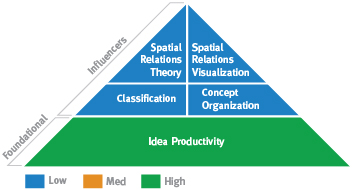
Abilities Constituting This Pattern
This pattern combines idea-rich (Idea Productivity) Pragmatic Problem Solving (lower Classification and Concept Organization) with intangible, practical spatial abilities (lower Spatial Relations Theory and Visualization). The first ability to take into account is your Idea Productivity. Strong Idea Productivity can help with problem solving because it allows you to come up with many possibilities. In communicating, since you are able to think of different ways to put your ideas, you may find that you are able to explain things to others quite easily. This can help in situations in which you are teaching or convincing others of the rightness of your ideas.
Your combination of scores in Classification and Concept Organization means that you are particularly able to learn from your experience of things. You are able to be in the present, and in fact, one of the ways you solve problems best is by paying attention to your experiences. Whenever you have a problem to face, giving yourself time to consult and make use of your experience can prove very helpful indeed to you. Your solution is likely to be pragmatic.
Your combination of scores in Classification and Concept Organization means that you are particularly able to learn from your experience of things. You are able to be in the present, and in fact, one of the ways you solve problems best is by paying attention to your experiences. Whenever you have a problem to face, giving yourself time to consult and make use of your experience can prove very helpful indeed to you. Your solution is likely to be pragmatic.
100
0
•
Classification
100
0
•
Concept Organization
100
0
•
Idea Productivity
100
0
•
Spatial Relations Theory
100
0
•
Spatial Relations Visualization
Your Scores (black dots) Relative To Required Ability Range
Additionally, your scores on the two spatial abilities reinforce each other. You are not going to relate well to mathematics or physical, three-dimensional space and objects. You are much more comfortable dealing in the intangible world of people, relationships, and ideas.
This combination of abilities is often seen in people who teach. It is also quite useful for people, such as lobbyists or people involved in fundraising, who may need to convince others of the correctness of their particular point of view. Additionally, salespeople often have this pattern.
This combination of abilities is often seen in people who teach. It is also quite useful for people, such as lobbyists or people involved in fundraising, who may need to convince others of the correctness of their particular point of view. Additionally, salespeople often have this pattern.
See next page for CAREERS TO EXPLORE.
Highlands Career Exploration Supplement
Careers to Explore for Brainstorming/Influencing - Practical Pragmatic
Organized by Job Families which are groups of occupations based upon work performed, skills, education, training and credentials.
Highlands Career Exploration Supplement
Assisting - People
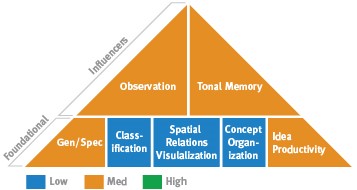
Abilities Constituting This Pattern
The Assisting - People pattern combines the personal style of a blended Generalist/Specialist with an idea-rich Pragmatic Problem Solving style (Idea Productivity, lower Classification and Concept Organization), comfort with dealing with intangibles (lower SRV), and attention to visual details (Observation) and the capacity to listen (Tonal Memory). People with this pattern are naturally wired to connect with, understand and be sensitive to others' needs and feelings - intangible elements of relating. They are patient and less likely to jump to conclusions when faced with new situations.
Relying on an experiential problem solving approach, those with this pattern are able to draw on their own experiences as well as those of others to build a powerful database of information, solutions, and positive outcomes. Once a situation is experienced, they are very quick to know what to do without overthinking. They use their ability to draw on past experience to master a set of skills and pragmatically solve problems.
Relying on an experiential problem solving approach, those with this pattern are able to draw on their own experiences as well as those of others to build a powerful database of information, solutions, and positive outcomes. Once a situation is experienced, they are very quick to know what to do without overthinking. They use their ability to draw on past experience to master a set of skills and pragmatically solve problems.
100
0
•
Classification
100
0
•
Concept Organization
100
0
•
Specialist
100
0
•
Idea Productivity
100
0
•
Observation
100
0
•
Spatial Relations Visualization
100
0
•
Tonal Memory
Your Scores (black dots) Relative To Required Ability Range
People with this pattern are instinctively driven to provide a balanced perspective. They like to offer “the other side’s” point of view for consideration. Naturally paying attention to visual details, remembering what they hear and then generating ideas, can convey attentiveness and engagement in the situation at hand. Others typically like and feel comfortable around people with this pattern, and want to do business with them. Success and advancement in many organizations is based on this factor alone.
This powerful pattern equips people to concentrate on the problems presented, to understand the sender, and to patiently work towards the best outcome for staff, clients, patients, students or even family members. Those with the Assisting- People pattern, with time and patience, can develop an area of expertise in almost any industry, and will likely be happy staying in the same industry for a long period of time.
Direction for this pattern is related to your unique interests. We recommend that before you review the suggested careers below, click this link, http://www.mynextmove.org/explore/ip, to explore your interests on ONET's free, 10-minute Interest Profiler.
This powerful pattern equips people to concentrate on the problems presented, to understand the sender, and to patiently work towards the best outcome for staff, clients, patients, students or even family members. Those with the Assisting- People pattern, with time and patience, can develop an area of expertise in almost any industry, and will likely be happy staying in the same industry for a long period of time.
Direction for this pattern is related to your unique interests. We recommend that before you review the suggested careers below, click this link, http://www.mynextmove.org/explore/ip, to explore your interests on ONET's free, 10-minute Interest Profiler.
See next page for CAREERS TO EXPLORE.
Highlands Career Exploration Supplement